Customer relationships
MLM CRM Software
Most direct selling platforms treat customers as an attribute of an order. That works until you need to know how many people bought from you twice, which is the single most useful number in the business — and the one a regulator is most likely to ask about.
What you get
Outcomes operators report after moving onto the platform.
A customer record, not an order field
One record per retail customer with full order history, whichever distributor sold to them and however many times they came back.
Reorder cadence, measured
Days between orders per customer and per product, so the second-purchase rate becomes a number you track instead of a feeling.
Subscriptions with real controls
Recurring orders with skip, pause, change-date, swap-product and cancel — self-service for the customer, visible to the distributor.
Retail versus internal, separated
Orders classify at entry as retail customer, preferred customer or distributor personal use, giving you the split as evidence rather than an estimate.
Abandoned and failed order recovery
Failed subscription payments and abandoned carts surface as work lists with the reason attached, not as silent revenue loss.
Consent recorded per channel
Marketing consent captured with timestamp, source and channel, because GDPR and POPIA both require you to show where it came from.
MLM CRM Software
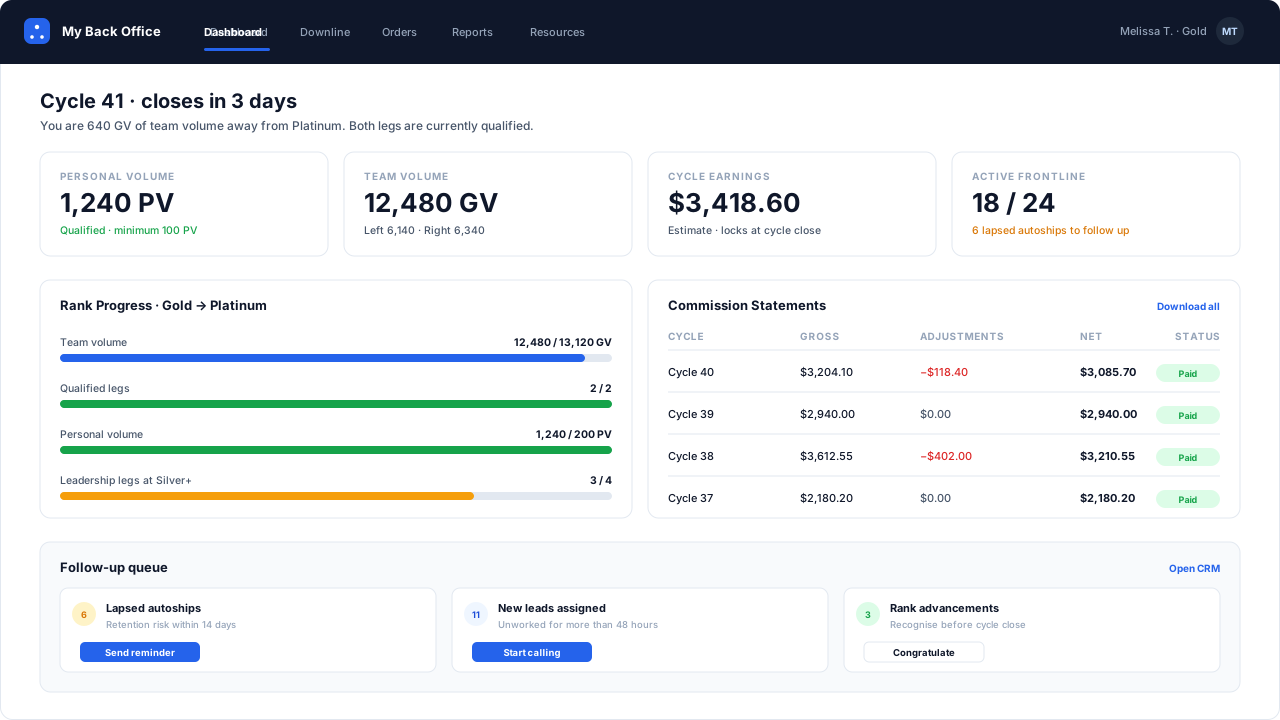
Distributor back office showing personal volume, team volume, rank progress and commission statements
The number most platforms cannot produce
Ask a direct selling company what proportion of its volume last quarter came from people who are not in the compensation plan, and you will usually get an estimate. Ask for the same figure broken down by distributor, and you will usually get a project.
The reason is structural. Most platforms in this category grew out of a commission engine, where the customer is a name and an address attached to an order. That is sufficient to ship a parcel and to pay a commission. It is not sufficient to answer the two questions that matter most about customers: how many of them came back, and how many of them are actually customers.
Customers are a different population
| Distributor | Retail customer | |
|---|---|---|
| In the compensation plan | yes | no |
| Cares about | volume, rank, team, commission | price, delivery date, reorder |
| Interface needs | genealogy, statements, wallet | order history, subscription controls |
| Held by | the company, in the plan | the company, served by a distributor |
Merging these two populations into one “user” concept is the usual shortcut and it degrades both sides. The customer receives an interface that talks about volume points. The distributor gets a customer list that is really an order list, so the same buyer appears four times.
Distributor-side tooling is covered on the downline manager page. This page is about the other half.
Reorder cadence is the health metric
A single number tells you more about a direct selling business than any other: what proportion of first-time retail customers place a second order, and how long they take.
It is worth stating why. Recruitment growth is visible, fast and easy to celebrate. Repeat purchase is slow, quiet and the only thing that indicates people want the product. A company with strong enrolment and a weak second-purchase rate is a company whose revenue depends on continuing to enrol, which is both a commercial fragility and a regulatory exposure.
So the CRM measures it: days between orders per customer, per product and per cohort, with the second-purchase rate reported as a standing figure rather than something you commission a report about.
Subscriptions, with the controls people actually use
Recurring orders are how repeat purchase becomes reliable, and they fail for an entirely mundane reason: the customer wants to skip one month and the only available option is to cancel.
The controls here are therefore skip one delivery, pause with a resume date, change the delivery date, swap the product, change the quantity, and cancel with a reason — all self-service, all visible to the assigned distributor.
Failed payments get a configurable retry schedule, a notification to the customer, and a recovery queue for the distributor with the failure reason attached. A subscription that dies silently on an expired card is revenue you lost to an administrative detail.
Classification at order entry
Every order is classified when it is placed: retail customer, preferred or subscribed customer, or distributor personal use. Not inferred afterwards from who the buyer is — recorded, on the order, at the time.
This is a small implementation decision with a disproportionate payoff. It gives you the retail proportion as a report by period and by distributor, it lets you exclude or include categories from volume qualification according to your plan rules, and it means the answer to a regulator’s question about retail sales is a query rather than a reconstruction from shipping addresses. The compliance framing is on the direct selling software page.
Consent, recorded properly
Marketing consent is captured per channel — email, SMS, post — with a timestamp, the capture source and the record of what the person was shown when they agreed. Unsubscribes are logged with the same detail.
Both GDPR and South Africa’s POPIA require you to be able to demonstrate consent rather than assert it, and in this industry the consent is frequently collected by an independent distributor at a party or over a message. Capturing it in the platform at the point of collection is the only version of this that survives being asked about later.
At a glance
| Customer types | Retail customer, preferred or subscribed customer, distributor personal use — each classified at order entry |
|---|---|
| Held per customer | Contact details, assigned distributor, acquisition source, order history, subscription state, consent record, lifetime value, notes |
| Subscription controls | Skip one, pause with resume date, change delivery date, swap product, change quantity, cancel with reason |
| Dunning | Configurable retry schedule on failed payments, customer notification, and a recovery queue for the assigned distributor |
| Retail reporting | Retail versus internal volume by period, company-wide and per distributor, exportable for compliance review |
| Consent | Per-channel opt-in with timestamp, capture source and IP, plus a full unsubscribe audit trail |
| Distributor visibility | A distributor sees their own customers only; corporate sees all, with role-scoped access to contact details |
Questions operators ask before they switch
Straight answers on plan mechanics, migration risk and compliance. If yours is not here, ask us directly.
What is customer relationship management software, in this context?
How is this different from downline or team management?
Why does the retail versus internal split matter so much?
Who owns the customer — the distributor or the company?
Ready to Transform Your Direct Selling Business?
Send us your plan rules and we will run a live commission cycle against them, on your numbers, before you commit to anything.
- Configured in a sandbox before the call, usually within two business days
- No slide deck and no card — you watch your own plan pay out
- Your plan document stays confidential and is deleted on request
Prefer email? Write to us at sales@mlmsoftwarepro.com