Commission engine
MLM Commission Software
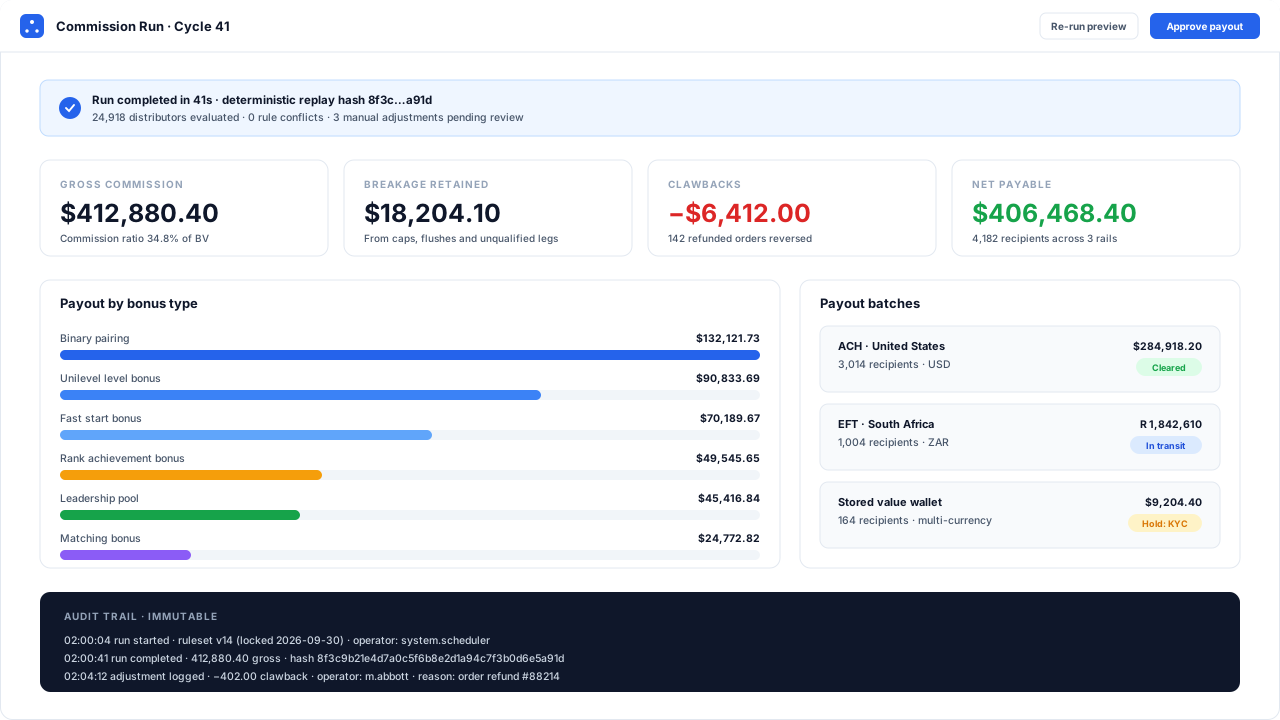
A commission run is an accounting event, not a report. Every line here records the order that generated it, the rule that paid it, the rate applied and the qualification state at run time — which is what turns a distributor dispute into a two-minute lookup.
What you get
Outcomes operators report after moving onto the platform.
Replayable runs
Rule sets are versioned alongside the run, so re-executing a closed period returns the numbers you paid rather than the numbers today's rules would produce.
Line-level audit trail
Order, rule, volume, rate, qualification snapshot and resulting wallet entry, for every line. Exportable and immutable.
Refund clawbacks that unwind correctly
A refund reverses the volume, re-evaluates the qualifications that volume supported, and adjusts the bonuses those qualifications paid — as adjustment lines, never as edits.
Any run frequency
Daily, weekly, bi-weekly, semi-monthly, monthly or per-cycle, with independent schedules per bonus type on the same plan.
Wallet and payout batching
Commission posts to an internal wallet ledger, then batches to payout providers with KYC holds, minimum thresholds and per-country routing applied.
Pre-run preview
Every run can be executed in preview mode against live data, producing the full output and cost breakdown without posting anything.
MLM Commission Software
Commission run summary with bonus type breakdown, payout batch status and clawback adjustments
What a commission run has to produce
Three artefacts, in this order.
- The payout figures. What each distributor is owed for the period.
- The explanation. For each figure, the lines that make it up and the rule behind each line.
- The evidence. A record that cannot be altered after the fact, showing what was calculated, from what, under which rules, and when.
Most platforms produce the first reliably. The second is often derived after the fact by re-running a calculation, which is why the explanation sometimes disagrees with the payment. The third frequently does not exist at all.
Why re-running against live rules breaks the audit trail
Consider a plan where the Silver rank requires 5,000 group volume. In January a distributor qualifies at 5,200 and is paid a rank advancement bonus. In March you raise the threshold to 6,000 because the plan is running hot.
An engine that recalculates on read will now report that the January distributor did not qualify — because it evaluates January’s volume against March’s threshold. The statement contradicts the payment, and there is no way to demonstrate which is correct. Distributors notice this, and it is corrosive out of proportion to the amount involved.
Versioning the rule set with the run removes the class of problem entirely. January pays and re-runs under January’s rules, forever.
How a refund unwinds
Refunds are the hardest case in commission software, because the effects cascade.
A $400 order refunded in period three had already contributed volume in period one. That volume may have qualified the sponsor for a rank, and that rank may have paid an advancement bonus and changed the percentage on every level commission in the subsequent period.
The engine handles this by re-evaluating rather than reversing:
- The refunded volume is reversed as an adjustment line against the original period.
- Qualifications that depended on that volume are re-evaluated at their original thresholds.
- Bonuses those qualifications supported are recalculated, and the difference posts as adjustment lines.
- The distributor’s wallet reflects the net, with each adjustment individually traceable to the refund that caused it.
Nothing is deleted, and every step is visible on the statement. Clawback policy — whether a negative balance is recovered from future commission, invoiced, or written off below a threshold — is configuration, because it is a commercial decision.
Payout, not just calculation
Calculated commission posts to an internal wallet ledger. Payout is a separate step with its own controls: minimum payout thresholds, KYC verification holds, per-country provider routing, batch approval with a second-approver option, and reconciliation against the provider’s settlement report.
Keeping calculation and payment separate is what allows a payout to be held — pending KYC, pending a compliance review, pending a distributor’s bank details — without the commission itself being recalculated or lost.
At a glance
| Bonus types | Level, pairing and cycle, matching, fast start, generation override, rank advancement, pools and shares, infinity, breakaway, custom rule |
|---|---|
| Compression | Dynamic and static, configurable per rule |
| Adjustment handling | Refunds, chargebacks, returns and manual corrections post as adjustment lines against the original run |
| Run modes | Preview (no posting), provisional (visible to distributors, not payable), final (payable and locked) |
| Audit retention | Full line-level history retained for the life of the account, exportable in CSV or JSON at any time |
| Tax on commission | US 1099 reporting data, South African VAT at 15% on distributor commission invoices where the distributor is VAT-registered |
Questions operators ask before they switch
Straight answers on plan mechanics, migration risk and compliance. If yours is not here, ask us directly.
What does deterministic actually mean here?
How are corrections handled if a run was wrong?
How long does a commission run take at scale?
Can distributors see how a specific commission line was calculated?
Ready to Transform Your Direct Selling Business?
Send us your plan rules and we will run a live commission cycle against them, on your numbers, before you commit to anything.
- Configured in a sandbox before the call, usually within two business days
- No slide deck and no card — you watch your own plan pay out
- Your plan document stays confidential and is deleted on request
Prefer email? Write to us at sales@mlmsoftwarepro.com