Integrations
MLM Software Integration
You should not have to replace a storefront that already works to add a compensation plan. The integration model is deliberately narrow: your store keeps the catalogue, checkout and customer experience, and the commission engine takes over attribution, volume and payouts.
What you get
Outcomes operators report after moving onto the platform.
Maintained storefront connectors
Shopify, WooCommerce, Magento and OpenCart. Orders map to distributors and post volume into the commission engine as they complete.
Documented REST API
Read and write distributors, orders, genealogy, commission lines and wallet entries. No part of the API is gated behind an additional fee.
Outbound webhooks
Enrolment, order, rank change, commission run completion, payout status and KYC state changes, with signed payloads and delivery retries.
Accounting and tax
QuickBooks, Xero and Sage for journals and commission invoices; integrated tax engines for US sales tax and South African VAT.
MLM Software Integration
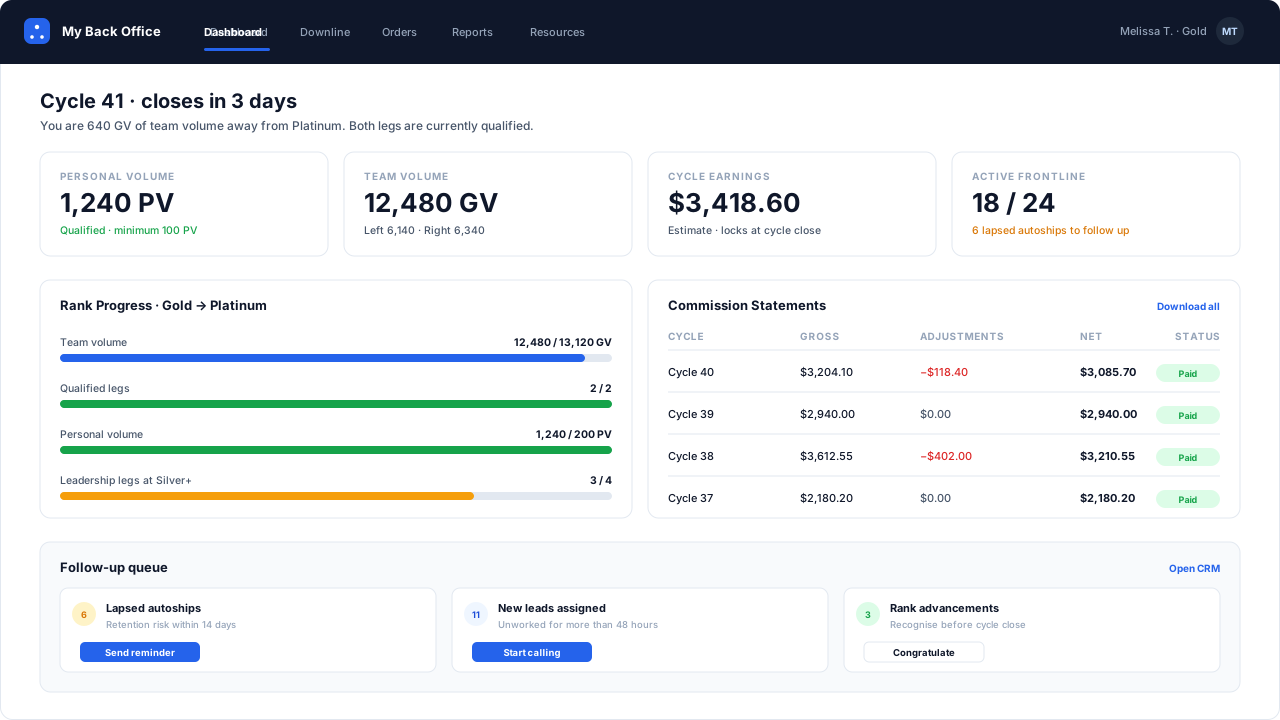
Distributor back office showing personal volume, team volume, rank progress and commission statements
The division of responsibility
An integration works when both systems keep what they are good at, and fails when they overlap. The line we draw is the same on every platform.
Your storefront keeps: the product catalogue, pricing and promotions, the cart and checkout, payment capture for retail orders, tax calculation on the sale, inventory, fulfilment and shipping, order status emails, and the customer-facing brand experience.
The commission engine takes over: distributor identity and enrolment, sponsor and placement trees, order-to-distributor attribution, volume classification (personal, group, leg, retail versus distributor purchase), plan rules and qualification, the commission run, the wallet ledger, payouts, and the compliance controls that depend on knowing whether a buyer is a customer or a participant.
The last item is the one that most often forces the decision. A storefront has no concept of a retail customer versus a distributor buying for personal use, and that distinction is the foundation of the evidence a US direct selling company needs.
Attribution is the part to get right
Everything downstream depends on correctly deciding which distributor an order belongs to. Five signals are supported, in priority order:
- An authenticated distributor placing their own order.
- A customer already assigned to a distributor in the back office.
- A replicated-site link or subdomain, persisted for the session and through checkout.
- A distributor-specific coupon or referral code entered at checkout.
- A default house account, if you configure one.
The order in which these resolve is configurable, because the right answer is a commercial one. A company that pays on lifetime customer assignment wants (2) to beat (3); a company that pays on last-touch wants the opposite. Whatever you choose is recorded on the order, so an attribution dispute is answerable.
Refunds, partial refunds and cancellations
The storefront remains the source of truth. When it reports a refund, the linked volume is reversed and the commission consequences unwind through the adjustment mechanism described on the commission software page. Partial refunds reverse proportional volume. Cancellations before fulfilment reverse the volume entirely.
Rate limits and reliability
The API applies per-endpoint rate limits, published in the OpenAPI specification. Webhooks are HMAC-signed and retried with exponential backoff for 24 hours, and every delivery is visible and replayable from the dashboard.
Beyond that, a reconciliation sweep runs every fifteen minutes against each connected storefront and compares order counts and totals for the trailing window. Dropped webhooks happen on every platform; the sweep is what stops a dropped webhook from becoming a commission discrepancy nobody notices until a distributor does.
At a glance
| Storefront connectors | Shopify, WooCommerce, Magento 2, OpenCartMaintained connectors with attribution, volume posting and refund sync. |
|---|---|
| Attribution methods | Replicated-site link, referral code at checkout, coupon code, subdomain, and customer-to-distributor assignment in the back office |
| Order sync latency | Real time via webhook, with a reconciliation sweep every fifteen minutes to catch dropped deliveries |
| API | REST over HTTPS, token authentication, per-endpoint rate limits, OpenAPI specification published |
| Webhook delivery | HMAC-signed payloads, exponential backoff retries for 24 hours, replay from the dashboard |
| Payments | Card, ACH, EFT, and regional providers routed per country; payout providers configured independently from checkout providers |
Questions operators ask before they switch
Straight answers on plan mechanics, migration risk and compliance. If yours is not here, ask us directly.
Does the storefront stay the system of record for orders?
What happens to orders placed before the integration went live?
Can distributors have their own replicated storefront on our Shopify?
What if we need an integration you do not have a connector for?
Ready to Transform Your Direct Selling Business?
Send us your plan rules and we will run a live commission cycle against them, on your numbers, before you commit to anything.
- Configured in a sandbox before the call, usually within two business days
- No slide deck and no card — you watch your own plan pay out
- Your plan document stays confidential and is deleted on request
Prefer email? Write to us at sales@mlmsoftwarepro.com