Mobile
MLM Mobile App Development
Almost every direct selling company wants an app, and most of them need a fast mobile back office instead. There are three specific reasons an app is genuinely the right answer, and if none of them applies to you, an app is a second codebase that will fall behind the first.
What you get
Outcomes operators report after moving onto the platform.
Distributor app
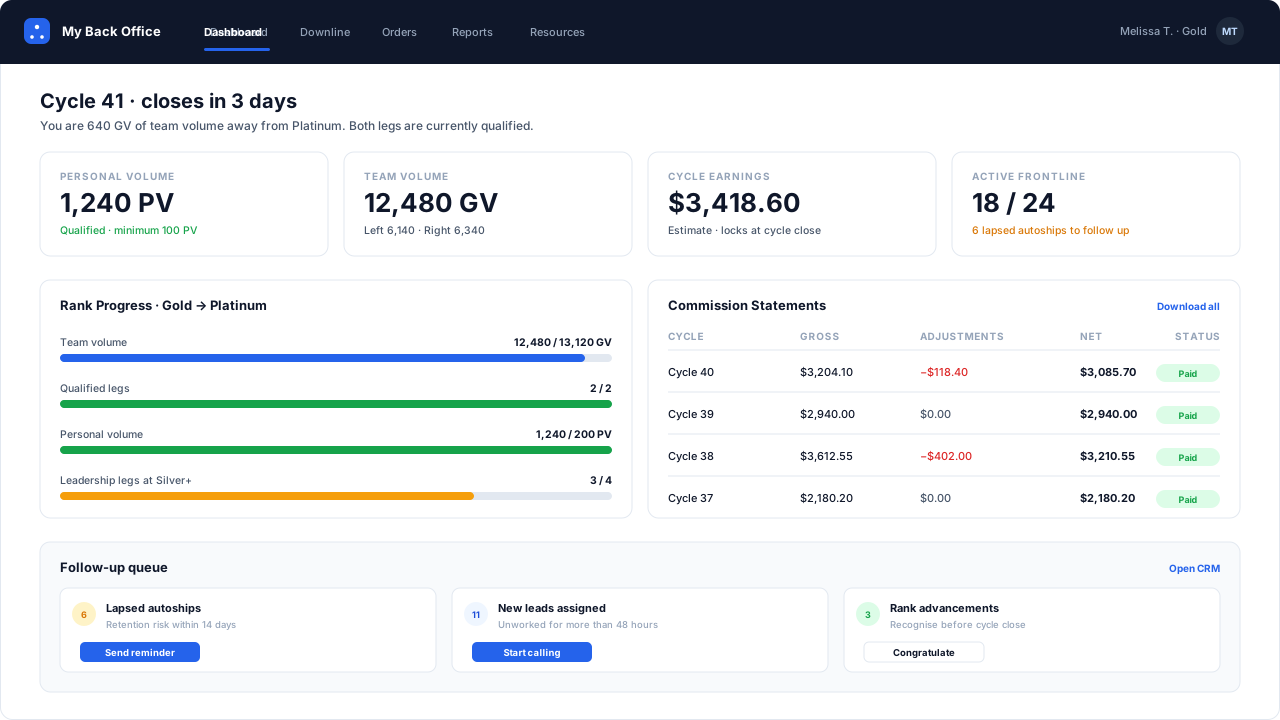
Volume and rank, team view, commission statements, wallet, and share links — the four things the field checks, built for the device they check them on.
Customer app where it fits
Reorder, subscription management and delivery tracking, for companies whose repeat purchase volume actually justifies a separate install.
Push notifications
The one capability a mobile site cannot match on iOS reliably, and the most common legitimate reason to build native.
One API, both clients
The app consumes the same documented API as the web back office, so a plan change cannot leave the two showing different numbers.
Store compliance handled
App Store and Play policies on income representations and on financial claims are stricter than most MLM marketing. We build to pass review.
Offline-tolerant order entry
Where the use case is genuine — party plan order taking in a room with no signal — orders queue locally and sync when a connection returns.
MLM Mobile App Development
Distributor back office showing personal volume, team volume, rank progress and commission statements
The question before the build
An app is the most requested item in a direct selling software project and one of the least examined. So the test first, because if you fail it, the money is better spent elsewhere.
Reason one: push notifications. A commission posted, a rank advanced, a payout sent — these are worth a notification, and web push on iOS is still not reliable enough to build a field communication strategy on. This is the most common legitimate reason and it is a real one.
Reason two: offline order entry. A party plan consultant taking orders in a room with no signal genuinely cannot use a web application. If this is your model, an app is not optional.
Reason three: your distributors will not use a browser. This happens, particularly in markets where app usage dominates and a browser is something people rarely open deliberately. It is a valid reason and it is also the one companies assume rather than check. Ask your field.
If none of the three applies, the honest recommendation is a fast mobile back office, which is what the network marketing software page describes.
What an app costs
| Cost | Effect |
|---|---|
| Install step before first use | drop-off at exactly the moment a new distributor is most fragile |
| Store review per release | a copy fix takes days instead of minutes |
| A second codebase | drifts from the web back office unless deliberately prevented |
| Two OS platforms to maintain | ongoing work unrelated to your business changing |
The install step is the underrated one. A distributor who enrols and wants to see what they earned should not encounter a download prompt first.
How we prevent the second-codebase problem
The app and the web back office are both clients of the same documented API. Not two implementations of the same logic — one server-side source of the numbers, consumed twice.
This matters most when the plan changes. If the app computes anything about volume, rank progress or commission on the device, then a rule change means a store submission and a period where some of your field sees old numbers. Everything derived is computed server-side; the app renders.
Content is server-driven for the same reason. Screens, copy, training material and announcements come from the platform, so most changes ship without a store submission at all.
Store review is a design constraint, not a formality
Both App Store and Play policies restrict income representations and earnings claims more tightly than most direct selling marketing does. Copy that sits unremarked on a website will fail review inside an app.
Both stores also require an in-app account deletion path, which for a direct selling company raises a question worth answering before you build: what does deleting a distributor account actually mean when that account has commission history, tax records and downline relationships attached. The workable answer is usually deletion of personal data with retention of the transaction record under a documented legal-obligation basis, and it needs deciding at design time rather than during a rejected review.
Apple’s rules on in-app purchase and external payment need attention where a starter kit, membership fee or subscription is involved.
On prebuilt apps and source code bundles
There is a substantial trade in this industry in ready-made MLM app packages and source code sold at template prices. It is worth understanding why they do not work, because the failure is structural rather than a matter of quality.
The compensation plan is the one part of this system that is specific to your company. It encodes your rates, your qualifications, your caps, your compression rules and your clawback policy, and it changes when your business changes. A package cannot contain it. So a prebuilt app either implements one fixed plan that you must adopt exactly, or it stops at the point where the plan begins — which is the point where the actual work starts.
We do not sell packages, and we will tell you during scoping if what you have described is smaller than the price of building it properly. The pricing page sets out what drives cost.
At a glance
| Platforms | iOS and Android, from a single codebase, with the web back office as the third client of the same API |
|---|---|
| Distributor app scope | Volume and rank progress, team view, order history, commission statements, wallet and payouts, share links, notifications, training |
| Customer app scope | Catalogue, reorder, subscription management, delivery tracking, distributor contact |
| Offline behaviour | Read-only cache of the last synchronised state; order entry queues locally and syncs with conflict reporting |
| Push | Rank advancement, commission posted, payout sent, order shipped, subscription failure — each individually opt-in |
| Store review | Built against current App Store and Play policy on income claims, external payment and account deletion requirements |
| Release cadence | App releases decoupled from web releases; server-driven content so most changes ship without a store submission |
Questions operators ask before they switch
Straight answers on plan mechanics, migration risk and compliance. If yours is not here, ask us directly.
Does our company actually need a mobile app?
What does an app cost you that a mobile site does not?
Will an MLM app pass App Store and Play review?
Do you sell app source code or a ready-made MLM app?
Ready to Transform Your Direct Selling Business?
Send us your plan rules and we will run a live commission cycle against them, on your numbers, before you commit to anything.
- Configured in a sandbox before the call, usually within two business days
- No slide deck and no card — you watch your own plan pay out
- Your plan document stays confidential and is deleted on request
Prefer email? Write to us at sales@mlmsoftwarepro.com